Developing Intentionality: A Legacy in 35mm
A reflection on returning to analog photography and how it reshaped my approach to modern software engineering.
We are living in an era of the “unnecessary upgrade”.
During my career in software engineering, I have seen this cycle repeat countless times. We are conditioned to believe that the next version or the latest framework is a prerequisite for better results. We have traded the deep understanding of our tools for the comfort of automation, and in the process, we have often traded away the “soul” of the craft.
For me, the realization did not come from a code editor. It came from a camera bag.
Two years ago, while sorting through my father’s things after he passed away, I found my old Nikon F50. This was the first camera I bought with my own first earned salaries as a teenager. Holding that SLR again after decades was a visceral experience. It was the bridge back to my youth, and it immediately captivated me. I needed to try shooting film again.
However, as I began to shoot with it, I remembered how the F50 functioned and how it was a “transitional” machine. It was one of the first of its kind, bringing digitalization where it was not necessary. With its automatic film lever and button-driven interface, it felt a bit too convenient, too automatic, and too much like a “point & shoot.” It possessed an excessive flamboyance that reminded me of the early digital interfaces I had spent my career building. It was analog, but it lacked the friction I was subconsciously looking for. I regretted having fallen into the “innovation trap” when I bought it.
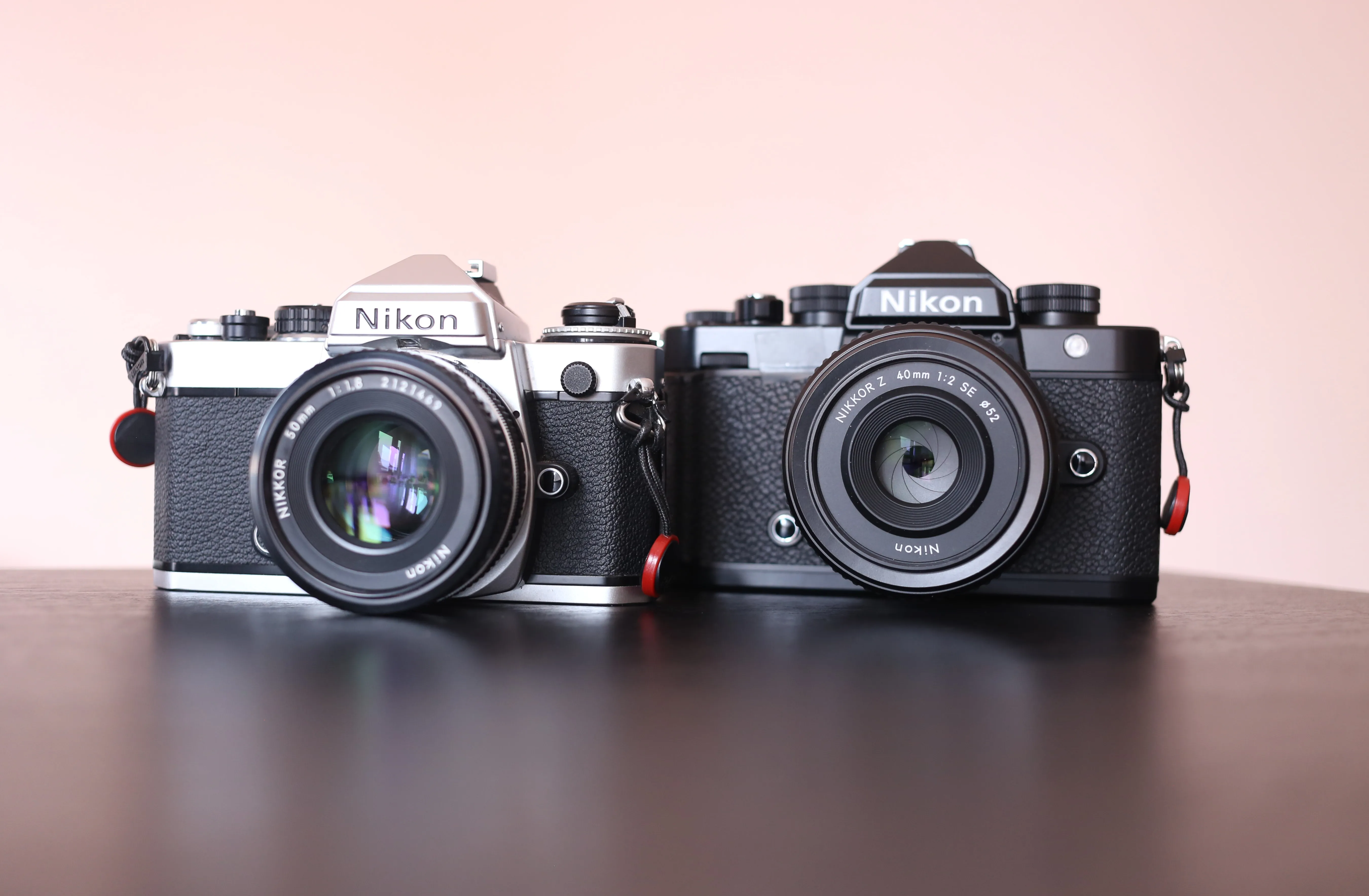
Driven by a need to feel the gears turn and to take back control of the user experience, I found a pristine, second-hand Nikon FE paired with a 50mm f/1.8 lens. No menus, no automatic winding, and no digital buttons. Just brass, glass, and a manual lever.
I have been shooting with the FE for over a year now, and it has fundamentally changed my perspective on production. When you only have 36 frames on a roll, every click has a price tag on it. You do not just “take” a photo; you produce it. You check the light, you visualize the exposure triangle, and, most importantly, you wait and wait until you are confidently certain you are ready.
This experience has not made me a Luddite. On the contrary, I still use my Nikon Zf, a modern mirrorless marvel, for much of my work. But the FE taught me something the Zf, or its other digital predecessors, could not: how to use a new tool with an analog mindset.
Because of that year spent with the FE, I find myself slowing down even when I have 128 gigabytes of memory at my disposal. I no longer “spray and pray”, hoping for a good shot among thousands. I treat the Zf as if it were loaded with film. I savour the moment first, and I record it second. I relive that famous quote from Sean Penn in The Secret Life of Walter Mitty: “Sometimes if I like a moment, I mean me, I don’t like the distraction of the camera. I just want to stay in it”.
There is a direct parallel here to software architecture. In tech, we are often “slaves to the upgrade”, running toward the newest stack even when the “legacy” system is performing its job perfectly.
Slowing down is not about being slow; it is about being intentional. Whether I am architecting a business-critical billing engine or composing a portrait on 35mm film, the goal is the same: to control the tool rather than letting the tool, and the market, control me.
We do not always need the “newest” thing to find the “best” way. Sometimes, we just need to remember how to savour the craft.